Where to Meet New People in Your 20s and 30s (That Aren’t Just Bars)
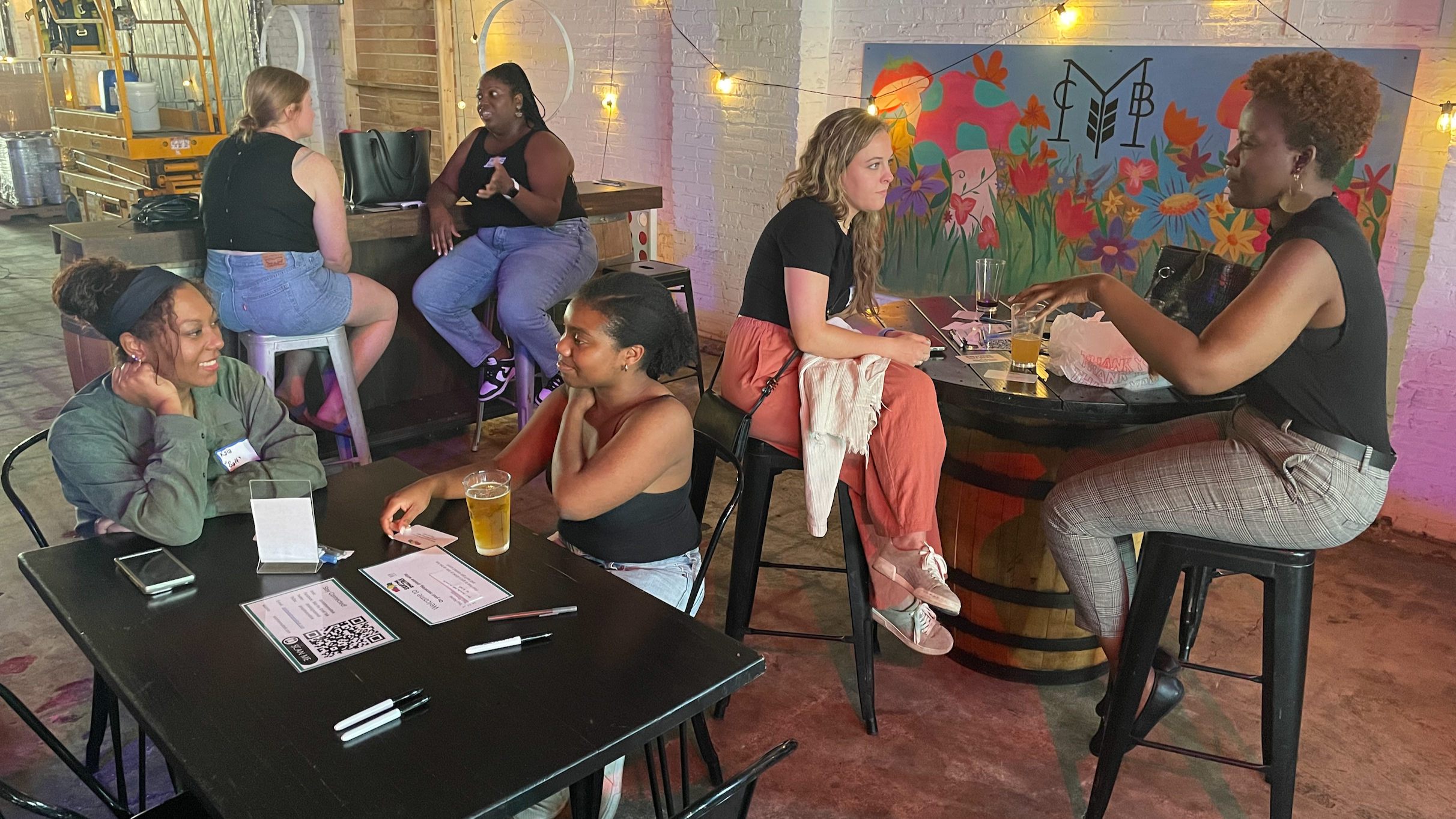
Folks meeting each other at a Skip the Small Talk event.
Where to Meet New People in Your 20s and 30s (That Aren’t Just Bars)
You’re not weird, this is actually hard
If you’ve ever looked around a room full of people and still felt weirdly alone, you’re not the only one.
A lot of people in their 20s and 30s hit this point where it suddenly feels… weirdly hard to meet people. Like, you can technically be around humans all the time—at work, at the gym, at a party—but actually connecting with someone new? That part feels way harder than it used to.
And if you’ve found yourself Googling things like “how to make friends as an adult” or wondering why it’s so hard to meet people, you’re also very much not alone in that.
After college (or after any built-in social environment), something changes. You’re not automatically surrounded by people who are also looking to make friends. Everyone’s schedules get fuller, social circles get more set, and suddenly it can feel like you missed some invisible window where this was supposed to be easy.
So then the default advice becomes: go to bars, go to parties, go “put yourself out there.”
Which… sometimes works. But also sometimes just means standing in a loud room, half-yelling “so what do you do?” and then going home thinking, wait, did I actually meet anyone?
If that experience feels familiar, it’s not because you’re doing something wrong. It’s because most environments just aren’t designed to make it easy to meet new people. That’s part of why structured social events designed for meeting new people can feel so different.
The good news is: there are better ways to meet people—and they don’t require you to love small talk or build your social life around drinking.
Why It’s So Hard to Meet People
If you’ve been wondering why it’s hard to make friends as an adult, a big part of the answer is structural.
In school, connection is built into your life. You see the same people over and over again. You have shared experiences, shared schedules, and a built-in reason to talk.
As an adult, most of that disappears.
Instead, you get environments where:
people already have established social circles
there’s no clear reason to start a conversation
everyone assumes other people aren’t interested in talking
So even if you want to meet people, you’re often stuck in situations that don’t actually support that.
It can start to feel like a personal failure—like maybe you’re not outgoing enough, or interesting enough, or trying hard enough.
But most of the time, it’s not a personality problem.
It’s an environment problem.
And once you see that, it gets a lot less mysterious—and a lot more fixable.
Why Bars Don’t Work for a Lot of People
If you’re looking for ways to meet people without drinking or places to meet people besides bars, you’re not alone.
Bars and parties are usually the default advice for meeting new people. And they can work—especially if you’re already going with friends or feel comfortable approaching strangers.
But for a lot of people, they make connection harder, not easier.
Here’s why:
They’re loud. It’s physically harder to have a real conversation.
There’s no structure. You’re left to figure out who to approach and how.
Social norms are unclear. Are people open to talking, or are they there with friends?
Drinking becomes the default—which doesn’t necessarily lead to meaningful connection.
There’s also this very specific moment where you’re standing there holding a drink, trying to make eye contact with someone else who also looks slightly lost, and neither of you knows if you’re allowed to talk. So you both kind of… don’t.
So you can end up “being social” without actually getting to know anyone.
If you’ve ever left a bar thinking, “I was around people, but I didn’t really meet anyone,” that’s a really common experience.
What Actually Helps People Connect (Backed by Psychology)
If you’re trying to figure out how to meet people, it helps to understand what actually makes connection more likely.
This is also what a lot of social psychology research finds: a few things consistently matter.
1. Repeated interaction
Seeing the same people more than once makes it much easier for connection to build naturally. This is why classes, groups, and recurring events tend to work better than one-off interactions.
2. Some kind of structure
When there’s a built-in way to interact—like prompts, activities, or guided conversations—you don’t have to rely on guesswork or social risk-taking.
3. Shared context or intention
It’s easier to talk when you already know you have something in common, even if it’s just “we both showed up here to meet people.”
When these elements are missing, meeting people can feel awkward and random.
When they’re present, it starts to feel surprisingly doable—like, oh, this is what this is supposed to feel like.
Where to Meet New People (That Aren’t Just Bars)
If you’re looking for ways to meet people that don’t just involve going to bars, here are some options that actually make it easier.
Structured Social Events (Designed for Meeting People)
These are events where the entire point is to meet new people—and the structure actually makes that easier.
Instead of having to “work the room,” you might:
have one-on-one conversations
rotate partners
get questions that make it easier to skip surface-level small talk
The big difference is that everyone there opted in.
You’re not interrupting someone’s night—you’re part of something where connection is the point.
Some of these events are designed specifically for making friends, which removes a lot of the weird ambiguity that usually makes meeting people feel hard.
At Skip the Small Talk, this usually looks like a series of short, one-on-one conversations with better questions than “so what do you do?”
We started hosting events like this over a decade ago, and since then, more events with similar formats have popped up—which is honestly a good thing. It means there are more spaces designed for real connection.
If ours isn’t the right fit, that’s okay—there are others out there now. (We’re biased, but we do think we’ve gotten pretty good at this over the past decade.)
If you’ve ever left a party thinking, “I was around people all night but didn’t actually meet anyone,” this kind of structure tends to solve that.
If you’re curious, here’s what to expect at a Skip the Small Talk event.
Classes and Workshops
Taking a class—whether it’s cooking, improv, art, or a language—is one of the most reliable ways to meet people.
You get:
a shared activity
repeated interaction
something to talk about immediately
Which means you’re not starting from zero every time you talk to someone.
If you want a way of meeting people that doesn’t feel forced, this is one of the easiest entry points.
Volunteering
Volunteering creates a shared sense of purpose, which makes conversation feel more natural.
You’re not just trying to meet people—you’re doing something together.
Having something to focus on together takes the pressure off—and makes it a lot easier for conversations to actually go somewhere.
It also gives you an easy way to start talking to people without overthinking it.
Interest-Based Communities
Book clubs, run clubs, hobby groups, and other interest-based communities can be great for meeting people.
The biggest advantage here is consistency.
You’re likely to see the same people again, which gives connection time to build—without having to force it all in one interaction.
Coworking Spaces and Social Work Environments
If you work remotely, it can get weirdly isolating. You can go whole days without talking to anyone new.
Coworking spaces or more social work environments can help with that—just being around the same people regularly makes it easier for conversations to happen naturally over time.
How to Choose the Right Way to Meet People (For You)
If you’re trying to figure out what might actually work for you, it helps to choose based on what feels doable.
If you don’t love small talk → structured social events tend to work best
If you like doing something while talking → classes or volunteering
If you want something low-pressure → interest-based communities
The goal isn’t to force yourself into environments that drain you.
It’s to find ones that make connection feel easier—or at least less exhausting.
How to Actually Turn These Into Friendships
A lot of people get stuck here.
Meeting people is one thing. Turning those interactions into actual friendships is another.
If you’re trying to turn these into actual friendships, a few things matter more than people expect:
Follow up. Even a simple “It was really nice talking with you” can be enough.
Expect it to take time. Most friendships build over multiple interactions.
Normalize a little awkwardness. It doesn’t mean it’s not working—it just means it’s new.
If it feels slower than it used to, that’s normal.
No one else got a secret shortcut—you’re just seeing the behind-the-scenes of how friendships actually form.
You’re Not Behind—You Just Haven’t Been in the Right Environment Yet
If meeting people has felt harder than it “should” be, it’s easy to assume you’re doing something wrong.
But a lot of the time, it’s just that the environments you’ve been in weren’t set up to make meeting people easy.
When you’re in a space where interaction is actually supported, the whole experience feels different.
It’s not that you suddenly became more outgoing. It’s that it finally feels easier to talk to people—and have it go somewhere.
If you want to try one of these environments for yourself, you can browse upcoming Skip the Small Talk events near you.